Get 10% Veteran Discount Now
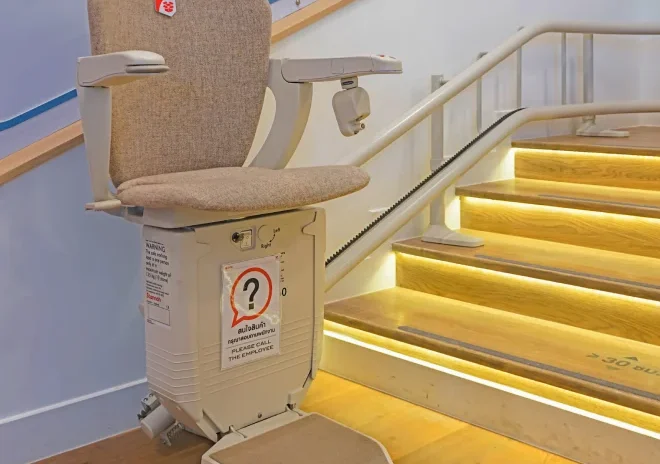
Quick answer: A stairlift that will not move may have lost charging power, have a key or power switch turned off, have a swivel seat or armrest out of position, or be held by an obstruction or safety edge. Check only the user-accessible controls and visible path. Never force the chair, bypass a sensor or remove a cover.
The steps below can help you identify a simple operating issue and give a technician useful information. They are not a substitute for the instructions for your exact stairlift model.
If someone is stranded on the stairlift
Keep the person calm and do not try to carry them on the stairs unless trained help determines that is safe. If there is an immediate medical danger, a fall risk or no safe way to transfer, contact emergency services. For a non-emergency equipment failure, call a stairlift service provider and explain that a rider is on the chair and where it stopped.
Stop using the lift if you notice a serious warning sign
- The chair slips, jerks, tilts or changes speed unexpectedly
- You hear grinding, cracking or repeated heavy clicking
- You smell burning, see smoke or find exposed wiring
- The rail or its fasteners appear loose or damaged
- The seat, armrest, footrest or belt is broken
In these cases, switch the lift off only if the normal user control is safely accessible. Keep others from using it and arrange professional inspection.
Nine safe checks for a stairlift that will not move
1. Confirm the main controls are on
Look for the normal key switch, rocker switch or on/off control used during everyday operation. Confirm it is in its operating position. Some lifts also have a separate isolation switch. Use the labels or manual for the exact model rather than trying unfamiliar controls.
2. Lock the swivel seat into its riding position
Most stairlifts will not travel while the seat is turned toward the landing. With the chair empty, rotate the seat gently until it clicks or locks into the forward-facing position. Do not force a seat that will not latch. A loose or unreliable swivel mechanism needs service.
3. Lower the armrests fully
On some models, an armrest must be down before the drive control will work. Confirm that both armrests are in their normal travel position and that nothing is caught beneath them.
4. Check the footrest and carriage safety edges
Safety edges are designed to stop the lift when they contact an object. Look along the visible rail and around the footrest for clothing, shoes, cords, pet toys or other loose items. Remove only an object that is easy to reach from a safe standing position. Do not reach under the carriage.
5. Check a folding rail or hinged section
If the lift has a manual or powered folding rail, confirm that the rail is fully in the position required for travel. Keep hands clear of hinges and moving sections. A folding mechanism that will not complete its movement should be serviced.
6. Verify power to the charger
Many stairlifts run on rechargeable batteries. The chair may stop after the batteries have been depleted because the charger was unplugged, a wall switch was turned off or a breaker or GFCI interrupted power. Check only visible, accessible connections. If a circuit trips again after one reset, do not keep resetting it.
7. Park the chair on a charging point
If the lift still has enough power to move and no warning sign is present, use the normal control to park the empty chair at its charging point. Allow time for charging. A lift that does not recognize the charge point, will not remain charged or stops again needs testing.
8. Compare the chair control and call/send controls
Try the user control on the armrest and then the wall-mounted or handheld call/send control, with the chair empty and the staircase clear. If one works and the other does not, the problem may be limited to a remote battery, remote pairing or that control. If neither works, note that for the technician.
9. Record any light, symbol, code or sound
A display or indicator can help identify the system that is preventing movement, but codes differ between brands and models. Take a photo or write down exactly what appears. Do not rely on a code list for a different model.
Why does my stairlift stop halfway up the stairs?
A mid-rail stop can have several causes: a safety edge may be touching an obstruction, a connection or charging problem may have left the batteries weak, or an electrical or mechanical component may need service. Note whether it stops at the same place every time and whether it will move in either direction. Do not push or pull the chair along the rail.
What not to do
- Do not bypass an interlock, sensor or safety edge.
- Do not remove covers or probe wiring.
- Do not lubricate the rail unless the manufacturer instructions for that model specifically call for it.
- Do not tow, push or force the chair.
- Do not keep resetting a breaker or repeatedly running a lift that stops.
- Do not use a damaged seat, belt, rail or footrest.
When to call for stairlift repair
Arrange service when the basic checks do not restore normal operation, the problem returns, the chair stops in the same place, the ride feels different or the charging system is uncertain. A technician can inspect the lift, test the batteries and charger, identify model-specific faults and determine whether parts are available.
Before calling, note the brand and model, the exact symptom, any code or light, where the chair stopped, which controls work and whether there was a recent outage or obstruction. That information helps make the service conversation more efficient.
Repair or replace?
A repair may make sense when the lift is otherwise dependable and the required parts are supported. Replacement may deserve consideration when problems are recurring, important parts are no longer available, the staircase or rider’s needs have changed, or the current lift is not the right configuration. Mobility Solutions – R.C.I. can discuss both stairlift repair and new straight, curved and outdoor stairlift installation.
Local stairlift help across the Twin Tiers
We serve homeowners and families from our Sayre, PA base throughout the Twin Tiers, including Binghamton, Ithaca, Elmira, Montrose and surrounding communities.
Call Mobility Solutions – R.C.I. at (570) 980-2561 or request service online. Tell us what the lift is doing and the make and model if it is visible.
Frequently asked questions
Why will my stairlift go down but not up?
A direction-specific problem may involve a control, safety circuit, obstruction or model-specific fault. Stop repeated attempts, note which control and direction work, and arrange service if the normal position checks do not solve it.
Can a power outage stop a stairlift?
Battery-powered stairlifts may continue for a limited time during an outage, but they cannot recharge without household power. How many trips remain depends on battery condition and the lift. Restore charger power when safe and schedule service if charging does not resume.
Should I reset my stairlift?
Use only the normal reset or power procedure described in the manual for your exact model. Repeatedly cycling power without understanding the warning can hide a recurring fault and does not replace a diagnosis.
Reviewed for Mobility Solutions – R.C.I. by Jeff Klossner, Owner/Technician. This article provides general safety information and does not replace the instructions for your stairlift model or an on-site diagnosis.